Blog

  • Hunger. Day 28 of Lent. How to find satisfaction.

    Hunger. Day 28 of Lent. How to find satisfaction.

    all_were_satisfied

    What are you hungry for?
    The question pops up whenever we set out for dinner. Sometimes we have a clear preference. Sometimes we’re indifferent. Sometimes we are craving Chuy’s Chicka-Chicka Boom-Boom Enchiladas or Tim Love’s bulgogi beef at the Woodshed. Other times we are starving and the nearest fast food is all we can wait for. But never in my life have I ever gone hungry. So blessed to live in a country where the supermarkets are never out of food and easily accessible and the food court at the mall is like a mini-Epcot center of foreign choices. We are well fed.

    But spiritually, what are you hungry for?

    Is your heart in tune with David? “O God, You are my God; I shall seek You earnestly; My soul thirsts for You, my flesh yearns for You, In a dry and weary land where there is no water.” Psalms 63:1

    Are you currently like a foreigner on a journey of faith that has lost his job or become disabled and provisions are shrinking. Maybe its chemotherapy that has your strength weakening and suddenly in this spiritual wilderness you find yourself really hungry. Famished for a word, any word at all from God, humbly realizing you were never really in control of your provisions when you were in your full strength. God is in control and now what you hunger for most is today’s promise that He will supply all that you need today.               “He humbled you and let you be hungry, and fed you with manna which you did not know, nor did your fathers know, that He might make you understand that man does not live by bread alone, but man lives by everything that proceeds out of the mouth of the LORD.” Deut 8:3

    Maybe you’ve been eating at the world’s banquet table and shopping at the world’s fashionable idol factories only to realize gluttonous, you are empty. Closet bursting, you have nothing to wear. You’ve had the latest and greatest all of a week and you’re already bored. Prov 27:20 reminds us, “Death and Destruction are never satisfied, and neither are human eyes.” But Jesus promises, “Blessed are those who hunger and thirst for righteousness, for they shall be satisfied.” Matthew 5:6

    How can our spiritual hunger be satisfied?

    For the bread of God is that which comes down out of heaven, and gives life to the world.” Then they said to Him, “Lord, always give us this bread.” Jesus said to them, “I am the bread of life; he who comes to Me will not hunger, and he who believes in Me will never thirst.” John 6:33-35
    Come daily to the Lord Jesus Christ and through relationship with Him talk about the things of the world you hunger and thirst for and ask Him to replace the appetite for those temporary things with a deep desire for His eternal things.

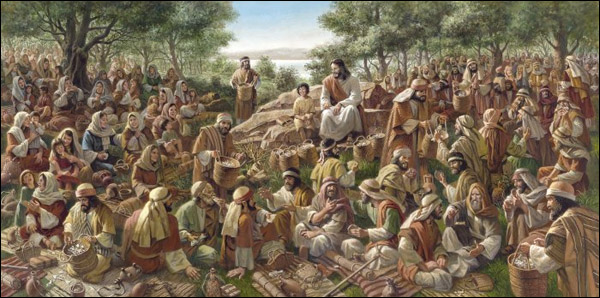
    All 4 gospels give the account of the small boy who provided his small lunch—which was everything he had at the time—that became the bountiful feast that fed over 5,000 hungry people who had gathered to hear the Lord Jesus teach. Perhaps the boy thought he’d give all that he had to simply feed Jesus that day but his love and his faith were miraculously multiplied and all were satisfied.

    You will have plenty to eat and be satisfied and praise the name of the LORD your God, Who has dealt wondrously with you; Then My people will never be put to shame. “Thus you will know that I am in the midst of Israel, And that I am the LORD your God, And there is no other; And My people will never be put to shame.” Joel 2:26-27

    Our mouths were filled with laughter, our tongues with songs of joy. Then it was said among the nations, “The LORD has done great things for them.” Psalm 126:2

  • Wander. 27 Day of Lent. Prone to wander?

    Wander. 27 Day of Lent. Prone to wander?

    prone to wander

    At the top of the list of favorite classic hymns is “Come, Thou Fount of Every Blessing,” which was written in 1757 by 22-year-old Robert Robinson, a newly converted ragamuffin who had recently become a Methodist preacher wrote this hymn to express his joy in his new faith but within the words we sense his internal struggle to remain faithful.

    Come, Thou Fount of every blessing,
    Tune my heart to sing Thy grace;
    Streams of mercy, never ceasing,
    Call for songs of loudest praise.
    Teach me some melodious sonnet,
    Sung by flaming tongues above.
    Praise the mount, I’m fixed upon it,
    Mount of Thy redeeming love.

    Sorrowing I shall be in spirit,
    Till released from flesh and sin,
    Yet from what I do inherit,
    Here Thy praises I’ll begin;
    Here I raise my Ebenezer;
    Here by Thy great help I’ve come;
    And I hope, by Thy good pleasure,
    Safely to arrive at home.

    Jesus sought me when a stranger,
    Wandering from the fold of God;
    He, to rescue me from danger,
    Interposed His precious blood;
    How His kindness yet pursues me
    Mortal tongue can never tell,
    Clothed in flesh, till death shall loose me
    I cannot proclaim it well.

    O to grace how great a debtor
    Daily I’m constrained to be!
    Let Thy goodness, like a fetter,
    Bind my wandering heart to Thee.
    Prone to wander, Lord, I feel it,
    Prone to leave the God I love;
    Here’s my heart, O take and seal it,
    Seal it for Thy courts above.

    As much as I love the hymn in its original version I have found it ironic to see how the lyrics have wandered from the Robinson original. In our church hymnal we sing an updated version that dropped ‘Here I raise mine Ebenezer.’ The following version was adapted by E. Margaret Clarkson in 1973:

    Hitherto Thy love has blessed me
    Thou has brought me to this place
    And I know Thy hand will bring me
    Safely home by Thy good grace
    Jesus sought me when a stranger,
    Wandering from the fold of God;
    He, to rescue me from danger,
    Bought me with His precious blood.

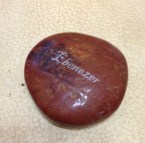
    Basically in our Biblically illiterate age Ms Clarkson thought no one knew what Ebenezer meant , most linking it to Dicken’s character Ebenezer Scrooge. Do you know what it means? Do you know what the difference is in a rock and a stone? If I see a rock in the woods on a hike, it’s called a ‘rock’ but if I take it from its natural place and put it in my garden, it’s called a ‘stone’. The rock itself hasn’t changed but what it’s being used for has, that’s why its name has changed to a stone. Below is an Ebenezer stone of help a friend gave to me.

    eb
    Ebenezer Stone of Help


    This small stone sits on my desk but in 1 Samuel 7:12 tells us that the prophet took a large stone and placed it between the towns of Mizpah and Jeshanah. He named the stone Ebenezer, which means ‘the stone of help’ for he said, ‘up to this point the Lord has helped us.’ Many times in the Bible (the stories of Noah, Joshua, Jacob, and Samuel are just a few) a stone was used as a reminder of how God helped someone.  An Ebenezer stone is anything that reminds us of how God has helped us in the past.

     Opps.

    rabbit trail...

    See, I’m prone to wander.
    Back to the point.  The editorial Wandering from the original version of “Come, Thou Fount of Every Blessing.” Some hymn editors had a more serious reason to edit the original words of Robinson based on a theological complaint with the song. In several hymnals “wandering” is replaced with “yielded,” and “prone to wander” with “let me know Thee in Thy fullness”.

    O to grace how great a debtor
    Daily I’m constrained to be!
    Let that grace, now, like a fetter,
    Bind my yielded heart to Thee.
    Let me know Thee in Thy fullness;
    Guide me by Thy mighty hand
    Till, transformed, in Thine own image
    In Thy presence I shall stand.

    Those in the holiness movement disagreed with the lyrics that sing, “Prone to wander, Lord I feel it, prone to leave the God I love.” Mark Altrogge says, “Though I know believers are tempted to wander and tempted to be unfaithful to Christ at times, I don’t see that Scripture says we are still ‘prone’ to sin and wander.” Rather, “The Bible says believers are ‘prone’ to obey the God they love. Prone to follow Jesus.”

    He cites Ezekiel 36:25-27 and these powerful words: I will sprinkle clean water on you, and you shall be clean from all your uncleannesses, and from all your idols I will cleanse you. And I will give you a new heart, and a new spirit I will put within you. And I will remove the heart of stone from your flesh and give you a heart of flesh. And I will put my Spirit within you, and cause you to walk in my statutes and be careful to obey my rules.

    Ricky Alcantar defends the original lyrics as he looks to the context of that verse, showing that Robinson is pointing to a genuine tendency to wander. “Within our lives are these opposing desires to honor God and to honor self, to flee from sin and to flee to it. This is the simul justus et peccator of Martin Luther and the “wretched man that I am” of Romans 7. The fact that we are simultaneously righteous and sinful, sinful in our actions and yet righteous in our standing before God. In good conscience I can continue to sing that I am prone to wander.”

    I think both sides have valid points, but I myself wish to sing with a voice poor in spirit as I lift begging hands up, ‘that God would bind my wandering heart to Him’. Within me is this constant competition, this brutal battle, between two “prones.”
    I believe I am being renewed, being made like Christ, holy, and through God’s sanctifying power sin’s power is lessened as a greater preference toward holiness overwhelms the inclination to wander toward sin.
    But  also “I know that all God’s commands are spiritual, but I’m not. Isn’t this also your experience?” Yes. I’m full of myself—after all, I’ve spent a long time in sin’s prison. What I don’t understand about myself is that I decide one way, but then I act another, doing things I absolutely despise. So if I can’t be trusted to figure out what is best for myself and then do it, it becomes obvious that God’s command is necessary. But I need something more! For if I know the law but still can’t keep it, and if the power of sin within me keeps sabotaging my best intentions, I obviously need help!
    I realize that I don’t have what it takes. I can will it, but I can’t do it. I decide to do good, but I don’t really do it; I decide not to do bad, but then I do it anyway. My decisions, such as they are, don’t result in actions. Something has gone wrong deep within me and gets the better of me every time. It happens so regularly that it’s predictable. The moment I decide to do good, sin is there to trip me up. I truly delight in God’s commands, but it’s pretty obvious that not all of me joins in that delight. Parts of me covertly rebel, and just when I least expect it, they take charge.
    I’ve tried everything and nothing helps. I’m at the end of my rope. Is there no one who can do anything for me? Isn’t that the real question?

    The answer, thank God, is that Jesus Christ can and does. He acted to set things right in this life of contradictions where I want to serve God with all my heart and mind, but am pulled by the influence of sin to do something totally different. Romans 7:15-25 MSG

    There are many areas in my life where I was once prone to wander, but am now prone to obey. This is not my doing. I know that I could never have tried hard enough to have victory over sin’s power over me by self effort. This spiritual growth is not some act of the will that has hardened me against wandering. Rather, this is the work of the Holy Spirit, by grace through faith giving me a greater preference toward holiness which overwhelms the inclination to wander toward sin.  I realize that the temptation to wander will never be gone in my life, but there is no doubt a greater power that binds my heart to His. Love.  I am loved by a great God that I come to love more and more and so I wander less and less.  God’s love is a powerful testimony to the transforming grace of God.

    King David the psalmist also wrote of this struggle to wander in His great anthem to the Scriptures, saying, “With my whole heart I have sought You; oh, let me not wander from Your commandments!” (Psalm 119:10)  A man after God’s own heart, David clearly prays that God would keep him from wandering.

    And Jesus affirms this wholehearted cry for help from the wanderers among us who beg for his tender love to bind us to Him.   “Blessed are the poor in spirit, for theirs is the kingdom of heaven.

    Live loved and wander less.

  • LIFTED. Day 26 of Lent. May Christ come in.

    LIFTED. Day 26 of Lent. May Christ come in.

    Psalm 24 Of David.

    Lift

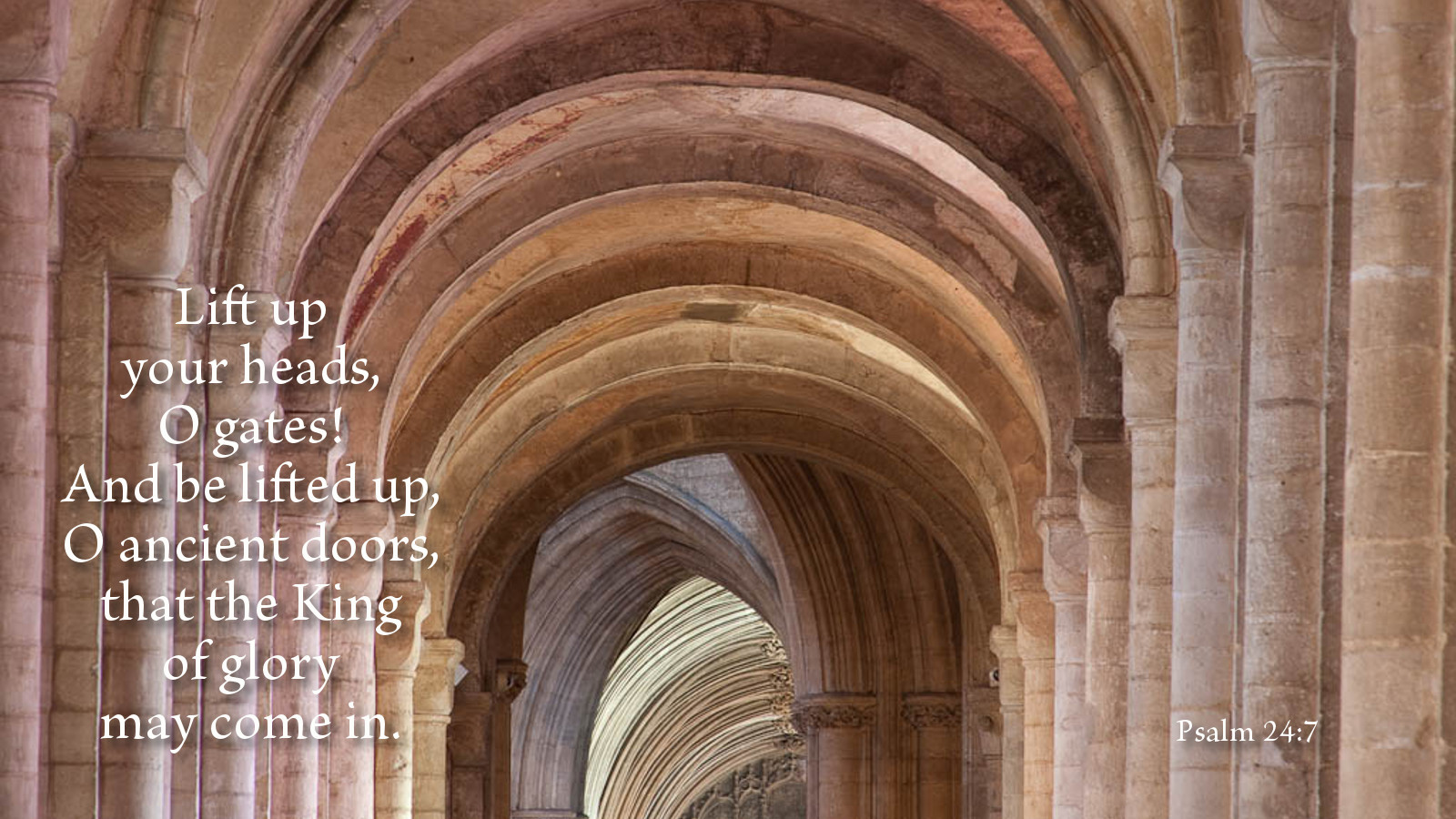
    Lift up your heads, O ye gates;
    and be ye lift up, ye everlasting doors;
    and the King of glory shall come in.

    Who is this King of glory?
    The LORD strong and mighty, the LORD mighty in battle.
    Lift up your heads, O ye gates;

    Even lift them up, ye everlasting doors;
    and the King of glory shall come in.
    Who is this King of glory?
    The LORD of hosts, he is the King of glory. Selah.

    David wrote this psalm for the splendid entry and return of the ark of the covenant into the tent David pitched for it, or the temple Solomon built for it.

    Lift up your heads, O ye gates.” Sang one half of a great choir, calling upon the gates to throw themselves wide open to their full height, that complete entrance might be given to the approaching sacred ark of God.

    And be ye lift up, ye everlasting doors.” Was the answering reply of the other half of the choir, giving the emphasis of repetition, and adding the “everlasting,” because the tabernacle was viewed as about to be continued in the temple, and the temple was designed to be God’s house “forever” (1 Kings 8:13).

    And the King of glory shall come in.”  God was regarded as dwelling between the cherubim on the mercy-seat, where the Shechinah glory from time to time made its appearance. So the entrance of the ark into the tabernacle was thus the “coming in of the King of glory.”

    The watchers at the gate hearing the song look over the battlements and ask, “Who is this King of glory?”
    Who is He in person, nature, character, office and work?
    What is his pedigree?
    What his rank and what his heritage?
    A question full of meaning and worthy of the meditations of all of eternity. The answer given in a mighty wave of music is,
    The Lord strong and mighty, the Lord mighty in battle.”

    We know the might of God by the battles which He has fought, the victories He has won over sin, and death, and hell, and in response we clap our hands as we see him leading the Host of heavens armies, majestic and glorious in His victorious strength as he enters in.

    Though David wrote this song for a specific occasion we can also apply it forward to the ascension of Christ into heaven. Our Redeemer found the gates of heaven shut, but having by his blood made atonement for sin, as one having authority, he now demands entrance. The angels were to worship him and ask with wonder at His arrival, Who is he? It is answered, that Christ is strong and mighty; mighty in battle to save his people, and to subdue His and their enemies, winning the great victory over death and sin.

    We may apply it also to Christ’s entrance into the souls of men by his word and Spirit at salvation, that they may be his temples. 
    Behold, he stands at the door, and knocks
    , Rev 3:20. The gates and doors of man’s heart are to be opened to him, as possession is delivered to the rightful owner and Creator.

    We may apply it to the broken spirit and contrite heart that God will not despise but instead the Spirit calls us to lift our faces up and receive the entrance of forgiveness and blessed favor of His love.

    We may apply it to his second coming with glorious power. Lord, open the everlasting door to the Kingdom of Heaven that we may be numbered with the saints in glory and lifted up to You.

    Who is this King of glory?
    The LORD of hosts, he is the King of glory.


  • GUIDE. Day 25 of Lent. Walk on.

    GUIDE. Day 25 of Lent. Walk on.

    GUIDE take a walk

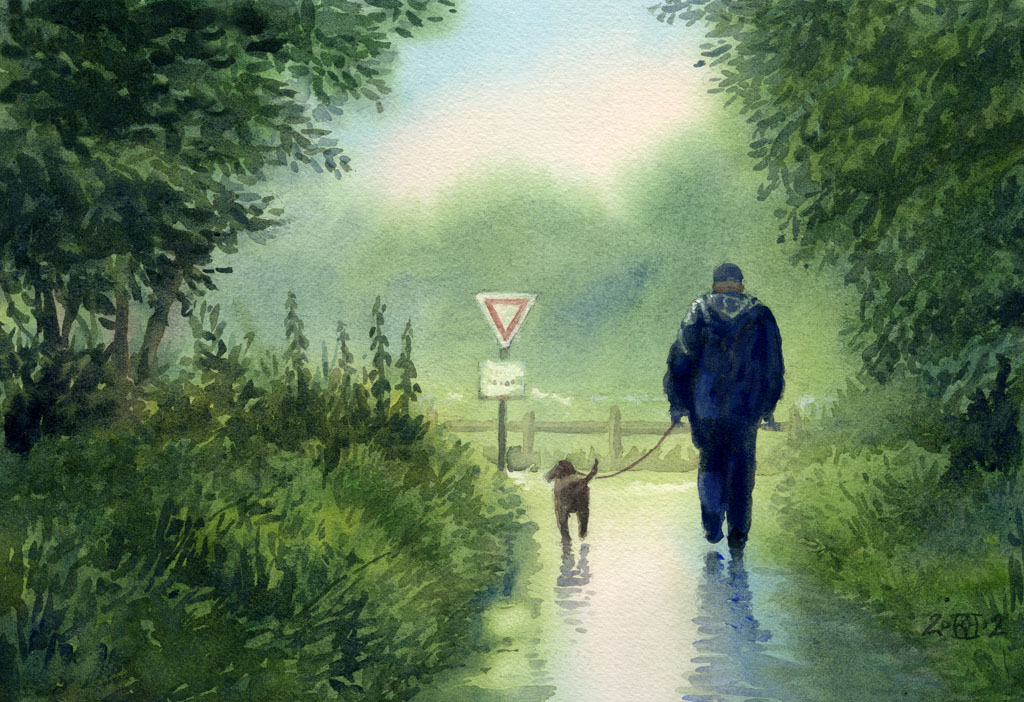
    They named him Moses of all things. This chocolate Labrador puppy with paws like a bear. And I met him when I was taking a jog one evening and he was crisscrossing the path of his owner as Bill tried desperately to get the puppy to walk on ahead.  But Moses was curious and energetic, tugging on his lead one moment only to hit the brakes the next and stubbornly hold back and dig in with his nose to the ground. His owner would have to tug him along, sometimes picking him up, untangling the leash and putting him out before him again to walk ahead. Moses the puppy was ecstatic to go on a walk but he hadn’t learned how to take a walk yet, that first meeting his owner, Bill, told me they both needed some help.

    The next week when I saw Moses he was linked in tandem with an older dog, learning what ‘walking’ was all about side by side with the mature Lab. By the next week Moses was back on his own leash walking independently with the older dog and his owner, Bill, being gently guided by the leash but obedient to the direction they were headed and the pace as he kept in stride with the older dog.

    Watching Moses learn to walk came as an object lesson as the Lord gave me this verse:

    I am God Almighty; walk before me and be blameless. Gen 17:1

    My response initial response to this call was, what?
    Wait, Lord. I thought I was to follow you, my Good Shepherd using prayer and God’s word and the accountability of fellowship with Christian friends. Following after Him was what I knew.  But I also knew I was prone to wander. . . do you have that problem?
    I would sometimes just get off track, fall behind, get lost even, and Jesus through the Holy Spirit would use the good ol’ rod & staff to ‘comfort’ me (ie Impart strength through discipline) or at times He’d gather me up into his arms and have to carry me like Moses the puppy.  Jesus had always been so good. So good at finding me and calling me back and I knew He’d promised to never leave me and that means I could never wander too far- there was an end to the leash, so to speak. And there was suddenly an end to following behind Him because God’s response was Yes.
    Walk before me and be blameless.

    I thought of Moses the puppy. I looked back at the verse and yoked myself to it so I would understand what this new call meant.

    Genesis 17 begins after thirteen years with no conversation recorded between God and Abram. Then in verse 1, God appeared to Abram and reintroduces Himself with a new name. GOD ALMIGHTY.  The Hebrew El Shaddai which means the God who pours out what we need, the God who is sufficient, all-competent, the adequate God who knows what He is doing and how to do it.
    Ray Steadman states, “It seems God tells Abram, You have been learning for thirteen years the total inadequacy of your own efforts through Ishmael. Now it’s time to learn a new thing about me. I am El Shaddai. You have discovered by sad experience how futile your plans and efforts can be without me. Now learn how capable I am to do everything that I desire to do, whenever I desire to do it.”

    God Almighty. El Shaddai. The all-powerful, all-sufficient God reveals himself to us as totally in charge and sufficient for whatever we are going through right now. Even if we’re coming out of a 13 year wander walk of self-sufficiency that’s birthed the bitterness of an Ishmael of failure, God is still capable to teach us a new way to go about life with Him.  And His word to us is a surprising call out of the silence of letting us wander our own way–Walk before me and be blameless.

    This is an invitation to remember and rest in God’s omnipotence. He is Almighty God. All things are possible to Him. He rules over all. All His power is working for those who trust Him. And all He asks of His servant is that he shall be perfect/blameless with Him.

    The root meaning of the word blameless is wholehearted.

    Walk before me and be perfect, wholehearted, God says, because I am El Shaddai. I am all-sufficient to make you blameless. Walk before Me, therefore, and be blameless.

    This invitation is first to remember and rest in God’s sufficiency and then give Him our whole heart, our perfect/complete confidence. God Almighty with all His power is wholly for us, so therefore be wholly for God.

    We wander because our hearts are constantly being divided trying to serve two masters, to please self and Christ. We are content to sit the fence- to serve Christ if we can also serve self at the same time. But God says, this can no longer be permitted.

    The folly of you following and dividing your attention, wandering and becoming lost in the impotency of self-sufficiency has come to a dead-end, your dual allegiance can no longer be tolerated if you are to grow. Walk now before Me, appropriating what I am, and be wholehearted, be wholly on my side, be mine!

    I often say when we first become a Christian we recognize Jesus as our loving savior, a friend to sinners but you keep making decisions on the basis of how you feel and what you want to do because we don’t know Him very well yet. As we grow in Him we come to call him Jesus Christ, understanding fuller what He appropriated for us, we realize we’re essentially different than we were before. But at some point we recognizing the right of Jesus Christ to be Lord of our lives and His name becomes the Lord Jesus Christ.  His willingness to save us involved His right to rule us. Now the Holy Spirit begins to assert the lordship of Christ in your life and you live more for Him and less for self.

    Walk before me.  Don’t think being called to perfection/wholeheartedness means a call to understand first the way you should walk. No, God’s way is the very opposite of this. Abraham went out, not knowing where he was going. We are called to walk on in faith abiding in Christ and we will be shown the way to go.

    So walk on ahead wholeheartedly Christian.

    Let your spirit be filled with His power: I am God Almighty.

    Let your life be spent in His presence: walk before him wholeheartedly.

    “For this God is our God for ever and ever: he will be our guide even unto death.” —Psalm 48:14

    “Trust in the LORD with all thine heart; and lean not unto thine own understanding. In all thy ways acknowledge him, and he shall direct thy paths.” Proverbs 3:5-6


  • INHERITANCE. Day 24 of Lent. Your claim in Christ.
    INHERITANCE. Day 24 of Lent. Your claim in Christ.

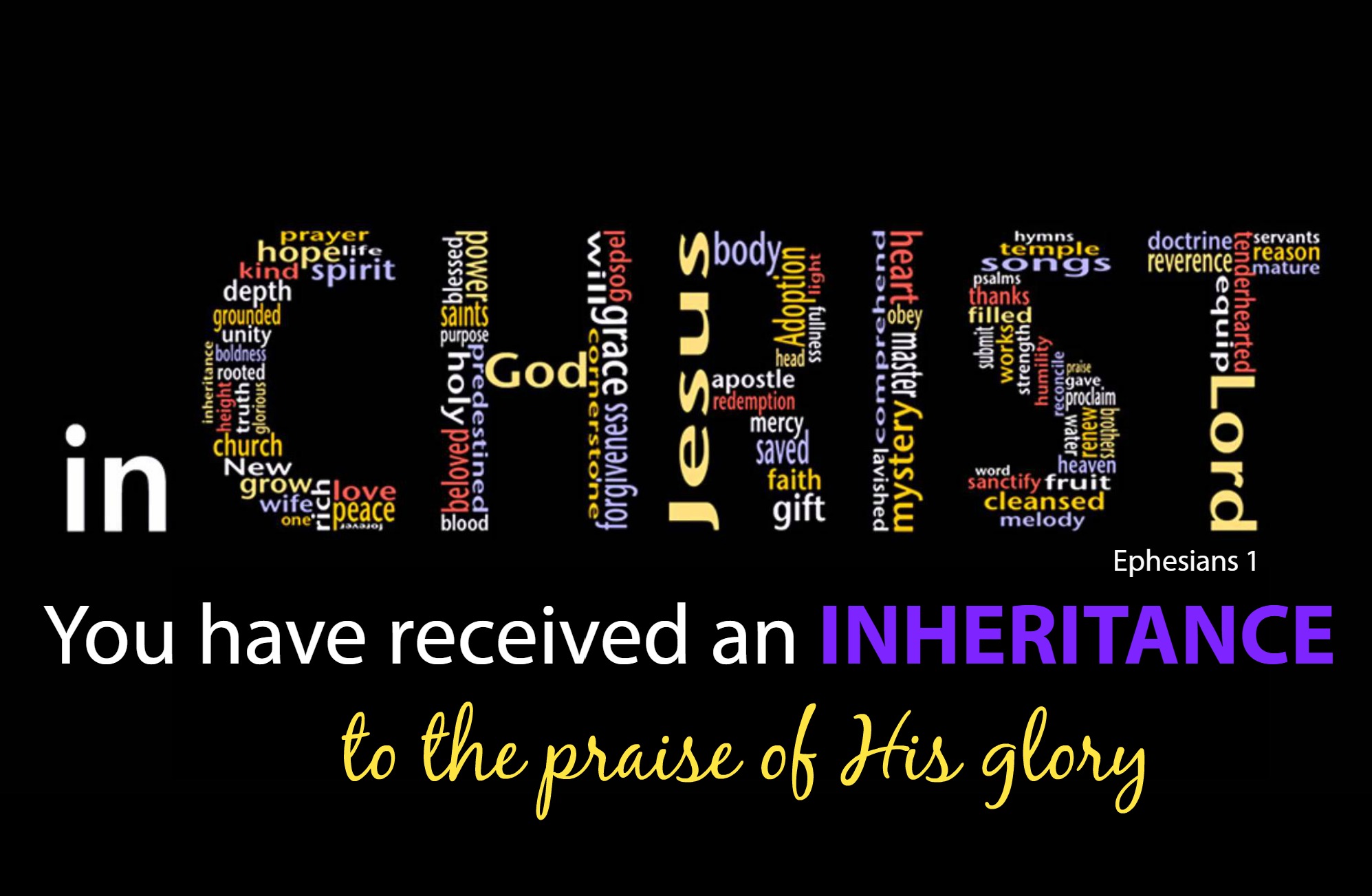
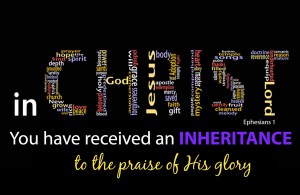
    11 In him we have obtained an inheritance, having been predestined according to the purpose of him who works all things according to the counsel of his will, 12 so that we who were the first to hope in Christ might be to the praise of his glory. 13 In him you also, when you heard the word of truth, the gospel of your salvation, and believed in him, were sealed with the promised Holy Spirit, 14 who is the guarantee of our inheritance until we acquire possession of it, to the praise of his glory. Ephesians 1:11-14

    What is our inheritance?

    Hebrews 1:11 is rendered in a variety of ways~
    (ESV) In him we have obtained an inheritance,
    (NLT) we have received an inheritance from God,
    (NIV) In him we were also chosen,
    (NET) In Christ we too have been claimed as God’s own possession,

    So are we claimed as God’s inheritance,
    or have we received an inheritance from God?
    The answer is both.

    An inheritance is God’s portion in his people (Heb 1:11)

    An inheritance is the everlasting portion which God has reserved for His people (Heb 1:18).

    F.F. Bruce in his commentary believes the best rendering for verse 11 is “we were claimed as his portion” because it corresponds best with OT passages. God has reserved for himself a portion of all the peoples of the earth to be his special possession, his treasured possession, his chosen people.

    An inheritance is hereditary succession to an estate or title; the right of an heir to succeed to property on the death of an ancestor; something that may legally be transmitted to an heir.

    Because of the work of the cross and the great victory of the resurrection we became joint-heirs with Christ and called the children of God. 

    For you did not receive the spirit of bondage again to fear, but
    you received the Spirit of adoption by whom we cry out, “Abba, Father.” The Spirit Himself bears witness with our spirit that we are children of God, and if children, then heirs; heirs of God and joint heirs with Christ, if indeed we suffer with Him, that we may also be glorified together. Romans 8:15-17

    And if you are Christ’s, then you are Abraham’s seed, and heirs
    according to the promise. Galatians 3:29

    Since God has claimed us as his inheritance, his heritage, his portion, therefore it can be said that we have obtained an inheritance, a heritage, a portion, the possession of all the benefits of salvation offered in Christ.

    you were sealed with the promised Holy Spirit, 14 who is the guarantee of our inheritance until we acquire possession of it, to the praise of his glory.” Ephesians 1: 13-14

    According to his great mercy, he has caused us to be born again to a living hope through the resurrection of Jesus Christ from the dead,4 to an inheritance that is imperishable, undefiled, and unfading, kept in heaven for you  1 Peter 1:3-4

    Our inheritance is the sum total of all God has promised us in salvation which is being lived out now and reserved for us in heaven for eternity.

    Our spiritual inheritance defines our position in God and who we are in Christ.

    ...the eyes of your understanding being enlightened; that you may know what is the hope of His calling, what are the riches of the glory of His inheritance in the saints, and what is the exceeding greatness of His power toward us who believe, according to the working of His mighty power which He worked in Christ when He raised Him from the dead and seated Him at His right hand in the heavenly places… Ephesians 1:18-20

    Our inheritance has an eternal scope.

    For our light affliction, which is but for a moment, is working
    for us a far more exceeding and eternal weight of glory. 2 Cor 4:17

    Oh, how great is Your goodness, Which You have laid up for
    those who fear You, Which You have prepared for those who trust in You In the presence of the sons of men! Psalms 31:19

    But as it is written: “Eye has not seen, nor ear heard, nor have entered into the heart of man the things which God has prepared for those who love Him.” 1 Corinthians 2:9

    Our Spiritual Inheritance Here & Now means that we actually begin to partake of His blessings right now and the Holy Spirit is the promise as a down payment.

    Elyse Fitzpatrick says it this way, “Our spiritual inheritance is being kept for us while we are being kept by Him.”

    How do we received our inheritance?

    By God’s purpose and will.  In him we have obtained an inheritance, having been predestined according to the purpose of him who works all things according to the counsel of his will, Eph 1:11

    We have received this inheritance also by hearing the word of truth, which is the gospel, and believing in Christ.  In him you also, when you heard the word of truth, the gospel of your salvation, and believed in him, Eph 1:13

    We have received this inheritance by the sealing of the Holy Spirit who is the guarantee of our inheritance until we take possession of it.  “were sealed with the promised Holy Spirit,  who is the guarantee of our inheritance until we acquire possession of it,”   Eph1:13-14

    A guarantee is something that assures a specific outcome. The Spirit is God’s guarantee to assure us that God will complete what he has promised.  Some call this the “already and not yet.”  F.F. Bruce writes, “Redemption is already ours through the sacrifice and death of Christ but one aspect remains to be realized. On the day of resurrection God will redeem his own possession, and the proof of His commitment to do so is the sealing of the Holy Spirit.

    Maybe the most important thing to consider is why has God given us an inheritance?

    God’s purpose in redeeming a people, in claiming us as his portion out of all the peoples of the earth is that we should give Him praise.

    But you are a chosen generation, a royal priesthood, a holy nation, His own special people, that you may proclaim the praises of Him who called you out of darkness into His marvelous light. 1 Peter 2:9

    God has claimed us as His own possession. We are the children of God. We should give Him praise for the indescribable gift of salvation and all its benefits, because we have done nothing to deserve it. If all we ever received was grace, it would be enough. Right? But God has given us so much more.  Is you heart grateful? Does your mouth witness and praise your Father God for his lavish love? Through him then let us continually offer up a sacrifice of praise to God, that is, the fruit of lips that acknowledge his name. Hebrews 13:15

    We should declare his praise with our lives.  I appeal to you therefore, brothers, by the mercies of God, to present your bodies as a living sacrifice, holy and acceptable to God, which is your spiritual worship. Romans 12:1-2
    We should declare his praise even with our thoughts and attitudes.

    That is God’s purpose for everyone whom He claimed as His own possession, to whom he has promised an inheritance, to live for the praise of His glory.

    Let the redeemed of the Lord say so. Psalm 107:2

    We should declare his praise. We should give Him praise.

    That is why you were claimed as his own possession, His special treasure, that you might declare his praise with your whole life.

    When we are in Christ, when we have received his Spirit, we are enabled to do this and to persevere to the end to receive our portion of God’s inheritance. We are enabled to give him thanks and praise even in trials and difficulties because we have his guarantee that we will receive what He has promised.

     See what great love the Father has lavished on us, that we should be called children of God! And that is what we are! 1 John 3:1

  • HEALING. Day 23 of Lent. We are sick.

    HEALING. Day 23 of Lent. We are sick.

    we are sick

    Jesus religious opponents once attacked him for having relationships with the ragamuffin characters like tax collectors and sinners. He was eating and drinking with them, having fellowship and a little too much ‘fun’ with the outsiders of the self-righteous. Instead of going to Jesus directly it seems they used gossip as the vehicle to transfer their outrage questioning the followers of Christ.

    While Jesus was having dinner at Levi’s house, many tax collectors and sinners were eating with him and his disciples, for there were many who followed him. When the teachers of the law who were Pharisees saw him eating with the sinners and tax collectors, they asked his disciples: “Why does he eat with tax collectors and sinners?” Mark 2:15-17

    On hearing this, Jesus said to them, “It is not the healthy who need a doctor, but the sick. I have not come to call the righteous, but sinners.”

    We are sick.

    Do you hear it? What Christ calls our condition? We are sick of soul and heart and mind, in motive and purpose and action. Sinners. Sick, sick people who need to be healed.

    Jesus is the great physician. His role as “physician” and healer is so prevalent in his ministry and so essential to Jesus’ mission that He cannot be understood apart from it. The crowds saw Jesus as a “physician” and it’s a title He deserves. Just skim the gospels and see the intentional attention Jesus gave to healing.  He was a healer whose time was consumed with encounters with people who were DIS-EASED-with a particular quality, habit, or disposition regarded as adversely affecting a person.  The sick, blind, lame, deaf, leprous, paralyzed or mentally ill were illustrations of the universal sickness we all carry in regard to sin. Unlike Luke the gospel writer who was a physician, Jesus healing ministry was different. He was neither a trained physician or a magician, but healed by divine power and could heal all who were brought to him not just a few people or ones with certain health problems.

    The divine healing power from Jesus went beyond curing ailing bodies or troubled minds. His healing was restorative, showing us sickness and therefore healing, is not simply a biological or physical phenomenon. Healing touches every level of human existence: physical, emotional, social, spiritual.

    Jesus’ touch did more than send healing power into sick bodies. Jesus’ power cut through barriers of isolation. Jesus’ compassion was a sign of solidarity with suffering people.

    When a leper approached Jesus asking to be healed, Jesus reached out past the ritual of impurity of the law and social standards. He was willing to physically touch the disease that forced the leper by law and social custom to live in isolation and misery. Today we might apply this to the AIDS patient or those with Ebola, the mentally ill or the physically deformed.  Christ broke down walls of alienation and prejudice by the simple yet powerful gesture of reaching out and touching the untouchable.

    Jesus healing methods often encouraged the active involvement of the sick in their own healing. He asked probing questions like ‘what is it you want me to do for you?” Gave clear instructions, “Stand up, pick up your mat, and walk!” Faith was a necessary factor in healing. “Faith,” as expressed in the healing stories in the gospels, involved a believing trust in God’s power and the determination to gain access to Jesus. Healing also involved the compassionate loved ones of the sick. Many times others interceded to bring friends and family to Christ.

    Today we follow the same pattern by believing in faith in Christ healing power and gaining access to Jesus through prayer for ourselves or interceding for others. Repeatedly, Jesus praised those He healed for their faith. Yet, a lack of faith from the people of Nazareth limited the healing of his hometown community.

    Jesus was often moved by compassion for the sick people and moved into their midst knowing what they needed was more than just physical healing but spiritual healing of the sin problem found in all of us.  Jesus never had to prove himself and refused to ‘perform’ healings for the self-righteous who stubbornly refused to accept the divine evidence of his power. But for those who were seeking to know and understand who He was the evidence proved Him as the anointed Christ.

    Even if we doubt, Jesus welcomes are seeking questions. When John the Baptist was in prison, he sent two of his disciples to ask Jesus whether he was “the one who was to come.” Jesus responded: “Go back and report to John what you have seen and heard: The blind receive sight, the lame walk, those who have leprosy are cured, the deaf hear, the dead are raised, and the good news is preached to the poor.” (Luke 7) Christ wants us to believe He has the power to heal.

    We are sick people. Sin and this sinful world cause all manner of pain. Pain tells us we have a problem. Jesus, the great physician, calls us to move toward our own pain, so that He can transform it. So often when we have pain, not just physical pain or illness, but a wound from childhood or a loss of some kind, or emotional pain, we try to get away from it instead of leaning into it.  We medicate it away. We want to dull it with alcohol or materialism or quick fixes. We deny it or avoid it or sometimes throw a party for it called pity.

    We focus on the pain instead of the physician.

    What if instead we stopped and switched directs. What if we returned to the Lord, and leaned into the pain instead of pushing back from it.  Starting with prayer, can we listen for God’s guidance to hear the method of His divine healing. Maybe the great physician will work through a skilled counselor or traditional medicine. Perhaps he will lead you to change your diet or begin new lifestyle habits. Maybe He will miraculously deliver you from it or systematically empower you to live with it as He did the apostle Paul reminding you  “My grace is sufficient for you, for my power is made perfect in weakness.” (2 cor 12:9)

    We are all sick and the sinners healing comes through faith, believing in the Great Physician and in faith determining to gain access to Jesus for the divine power of His healing.

  • Beauty. Day 22 of Lent. Beholding Beauty.

    #Beauty. Day 22 of #Lent. Beholding Beauty.

    You-are-beautiful

    Philosophers claim the highest forms of beauty are purposeless. That means we see something and universally agree that it is beautiful and find pleasure in viewing them.

    Michelangelo’s David will overwhelm you with its beauty regardless of your knowledge of the sculpture, where its marble was quarried, who sponsored the art, or what sources of inspiration or goals Michelangelo had in sculpting it. We don’t need art training to identify the beauty we see or a course in philosophy to recognize how beauty is observed. Recognition of physical beauty is an exercise through observation that is independent of the knowledge of how the object came into existence.

    This view can easily be applied also to the appreciation of beauty among human beings. To see the beauty of a person you need not know their story. No need to learn about their origins, education, occupation, how today’s been going for them or if they sought, worked or suffered to be beautiful.  Beauty may reveal itself in a person simply by observing them even at a glance.

    Purposeless beauty, however, may lead to deep misunderstandings. You may believe that you are indeed appreciating the beauty of Michelangelo’s David, but because of your art ignorance, you miss the real values of beauty that it expresses. It often happens with people too.

    So what exactly is beauty?

    The Dove Campaign asked women and found that:
    77% strongly agree that beauty can be achieved through attitude, spirit, and other attributes that have nothing to do with physical appearance.
    89% strongly agree that a woman can be beautiful at any age.
    85% state that every woman has something about her that is beautiful.

    The study found that 2/3 of women strongly agree that physical attractiveness is about how one looks, whereas beauty includes much more of who a person is.

    In a glance we can say someone is attractive.
    Through a relationship we discover someone is beautiful.
    We need to be more intentional with our word choices.

    Especially when the World seeks to praise physical beauty and links it to pleasure and power. Vanity, seeking beauty as a means to achieve pleasure can lead to hedonism, the typical symbol of decadence. Eros or physical love is sensual in nature. It is defined as a longing which in contemplation becomes an appreciation of the beautiful, or even becomes appreciation of beauty itself. Eros is always looking only skin deep. The Agape love that Christians are to pursue is a selfless love that seeks to connect with another through relationship. Our knowledge of another allows beauty to be discovered and we smile and say, “You are so beautiful.”

    Beauty is defined by God and He set the standard for beauty.

    Song of Solomon 4:7 You are altogether beautiful, my love; there is no flaw in you.

    1 Peter 3:3-4 Do not let your adorning be external—the braiding of hair and the putting on of gold jewelry, or the clothing you wear— but let your adorning be the hidden person of the heart with the imperishable beauty of a gentle and quiet spirit, which in God’s sight is very precious.

    Proverbs 31:30 Charm is deceitful, and beauty is vain, but a woman who fears the Lord is to be praised.

     Ecclesiastes 3:11 He has made everything beautiful in its time.

    It takes time to discover beauty, through relationships that look deeper than the skin. Do you realize yet how beautiful you are to God.

    Live Loved beautiful.

  • RENEW. Day 21 of Lent. For everything there is a season.

    RENEW. Day 21 of Lent. For everything there is a season.

    renew

    When I see a Robin in late winter I know Spring is coming.
    And when the Bradford Pear Trees sprout like winter snow, I know it is here. But it is this one winter tree I have learned to watch. With fall long past, it is the one that has that cluster of dead leaves still hanging on even after Winter’s worst was heavy upon its branches. Yet still a few leaves cling fast, so misplaced, stoically strong. So stubbornly stuck that Life itself must push the dead from the branch.

    Then the tree is renewed.

    Spiritual renewal comes often that way. We hold on to the comfortable. We’re begrudging creatures.  Stubbornly dead. Stuck. The end of some seasons like death and the grief often so hard that we are sometimes found in Winter still clinging to Fall. And we’ve refused to let go. To take our rest. To be bare and quiet and silent and ready. To listen through the winter, looking for the Robin. The first sign, thought, inclination that something new is coming soon. Life about to spring forth from what feels so dead. Even when we are still holding on to the last remains of a past season, God renews us. New life pushes out the dead. The birth of tiny buds of green forces old leaves to finally fall. God is so faithful in His transformation process.

    For everything there is a season and a time for every matter under heaven.” Ecclesiastes 3:1

    All of life relates to seasons. And Solomon tells us “for everything there is a season”-Everything. Every. Thing. In my circle of friends I have retired widows and young single career women. I know empty nesters adjusting to the new quiet and newlyweds praying for babies. Friends recovering from divorce and others fighting disease. All different seasons. And God has made everything beautiful in its time.

    Whatever season you are in, be, there. Yearning for what’s next or mourning what’s in the past causes us to shift our focus off the spiritual call to Abide.  We’re like those dead leaves out of season. We’re distracted and discontent. We’re afraid. All things we’re called not to be in Christ.  Yes some seasons are extremely difficult. The wait of winter is hard and its storms can be fierce but its pure peace can be beyond understanding. The heat of summer is exhausting, the mosquitoes annoying but the color and the bounty, glory. Fall is bursting full with color and the harvest of activity just as spring is sprouting with fresh new growth and possibilities but both carry with them the side effects of headaches and runny noses from the allergens.  Each season has its glory and its groans and if our lives were one continuous season we wouldn’t have the changes we need to transform us.

    We are born and then we die. Life so fragile and fleeting. We are back to remembering we are DUST. And knowing that truth helps us to live intentionally and make the most of each day.

    So embrace whatever season you are in now. Today. By abiding in Christ. Be you right there, in Christ, with Christ as He works in you and through you. Don’t long for another season. The days may be long, but the years seem so short. So be, there, abide, with Him.
    He makes everything beautiful in its time.


  • ABIDE. Day 19 of Lent. Christ final lesson.

    ABIDE. Christ Final lesson.

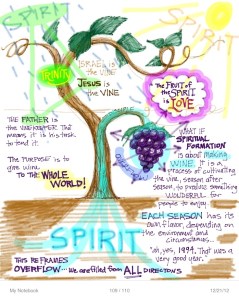
    the-Vine-and-the-Branches-Trinity

    John 15 records Christ final lesson to his dearly loved disciples.  They like many of us, still think God does His transforming work through our efforts and on our terms.  I believe these men were frustrated, confused, and even resentful that the Messiah was not living up to their expectations of becoming King and overthrowing the oppressive rule of the Romans to give them freedom but instead was talking about service and sacrifice. I think many Christians have the same look on their faces today.  Living this Christian life has turned out differently than you expected. You’ve tried so hard but freedom from habits and sin hasn’t been found.  Maybe today, if we can step into John 15. Be there in the vineyard. Hear, with spiritual ears, the Lord’s teaching of what is required of his followers we might find ourselves in that sweet spot. The Great Ah-Ha Moment that fans into flame a paradigm shift of the soul.  May God’s Spirit in this moment speak to your spirit in a way that you can grasp this truth.

    I give the honor of the presentation of this message to one of my favorite teacher/pastors, Steve Thomason.  He is a gifted artist and his visual imaginative teaching of this passage is phenomenal.


  • WATER. Day 19 of Lent. The Water in you.

    Water. We’re made of the stuff.


    water in you


    I’m not a bath girl but since my Spin Off I’ve been immersing in Epsom salt baths to help with the inflammation to my quads. I’ve also been drinking more water than I think I’ve ever consumed in a single day in my life to flush the protein toxins from my kidneys. After my week of Rhabdomyolysis, I’m floating. Literally. My body is just a float; far from Diet Sodas or the caffeine of that afternoon Iced Tea or the morning mug of coffee. I’m one big bloat of H2O.

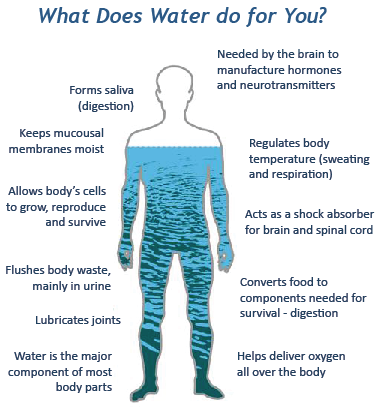
    Did you know up to 60% of the human adult body is water. According to H.H. Mitchell, the brain and heart are composed of 73% water, and the lungs are about 83% water. The skin contains 64% water, muscles and kidneys are 79%, and even the bones are watery: 31%.

    Each day humans must consume a certain amount of water to survive. Generally, an adult male needs about 3 liters per day while an adult female needs about 2.2 liters per day. Some of this water is absorbed through our food digestion.  All this hydration serves a number of essential functions to keep us all going:

    Water acts first as a building material in our cells and is a vital nutrient to cell life. Hydration regulates our internal body temperature by sweating and respiration. The carbohydrates and proteins used as food are metabolized and transported by water through the bloodstream.  Water also assists in flushing out waste through urination, forms saliva and lubricates our joints. Water also acts as a shock absorber for the brain and spinal cord and a growing fetus.

    The water in you is critical for survival. And even though it seems I’ve overindulged in water, it’s the healing properties of water at work in my body that will restore my health.

    The element of Water is creative and expressive, full of deep and symbolic Spiritual meaning.  In her book Hiding in Plain Sight, Molly Wolf lists, “The water of life, the water of baptism, the water that cleanses and heals, the water that breaks down and destroys, the water that lifts us and floats us when we come aground, the water that churns and pounds us out of our complacency and into awareness; the water of swamps and sloughs and soggy despond; the roiling sea-ice powerfully sculpting a coast; soft groundwater, tenderly upwelling to green a barren landscape; the singing chuckle of a creek, the roar of a fall, the calm assurance of a great river, the crash of a sea swell, the quiet privacy of fog, rain washing or slashing or downpouring or falling gentle as a leaf; the soft healing, or bitter springing, or joyful welling of salt tears. . . . God be praised for the gift of water.”

    “What is the scent of water?”
    “Renewal. The goodness of God coming down like dew.”
    ― Elizabeth Goudge, The Scent of Water