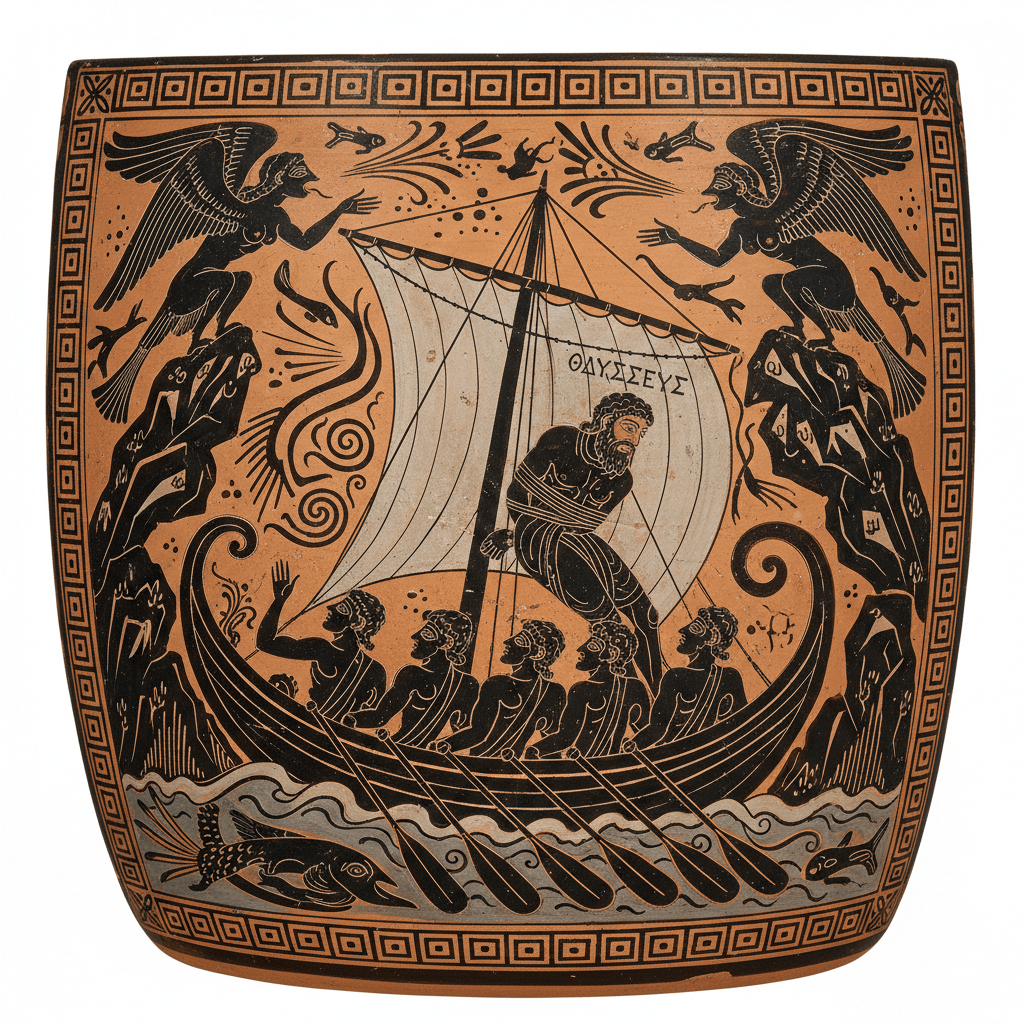
Where I Bind Myself
I want to explore a story about one of the most dangerous moments in Homer’s Odyssey and why this story now belongs to me.
As Odysseus sails toward home, Circe stops him. Not to seduce him this time, but to warn him.
She speaks plainly. Without enchantment.
Ahead are the Sirens. Their voices are irresistible. Every sailor knows this. Every captain has been warned. The rocks are littered with wreckage and bones.
Knowledge has never been the problem.
Circe does not say, “Be strong, Odysseus. You’ve got this.”
She does not say, “Just don’t listen.”
She knows better than that.
Instead, she gives him wisdom shaped by compassion, because she knows the essence of Odysseus.
Stuff your sailors’ ears with wax so they cannot hear the song.
But you, Odysseus, you may listen.
On one condition.
You must be bound tightly to the mast.
And no matter what you say.
No matter how you beg.
No matter how convincing you become.
You will remain bound.
And your men will keep rowing toward home, unaffected.
This distinction matters more than anything else.
Listening is not the same as steering.
The Nature of the Song
The Sirens do not lure with cheap pleasure. They sing something far more dangerous.
They sing of recognition.
“Come here, legendary Odysseus.”
They know his name.
They know his story.
They know his grief, his losses, the exhaustion soaked into his bones.
They offer not indulgence, but meaning. Not distraction, but understanding. They sing of values, of glory, of hope, of home.
They sing, I see you. I understand what this has cost you.
And then they promise something more perilous still.
They claim to know what lies ahead.
Whether there is hope.
Whether it will be worth it.
What song could be more enticing?
To be known.
To know.
To believe the suffering has a logical end.
This is why Circe allows him to listen.
To refuse the song entirely would be to deny something deeply human. The longing to have suffering named. The longing to believe our dreams might still come true.
Where I Lost My Way
For years, I misunderstood this wisdom. I was not ruled by self-absorption. I was ruled by fear.
Fear learned through comparison.
Fear that whispered something essential was missing.
Talent. Worthiness. Permission.
I rowed for nearly seven years in circles, measuring myself against voices that were never meant to be navigational. I handed others the power to grade my value, to decide whether my work, my longing, my presence was too much or not enough.
Often, my own voice was the harshest examiner of all.
My ears were stuffed with wax.
Not because I was disciplined, but because I was afraid.
Afraid that the ache in my heart would never be understood.
Afraid to hope for a calling that might once again disappoint.
Afraid to believe that my longing carried meaning rather than deficiency.
So I cut myself off from the very song I was made to hear.
And in doing so, I lost my ability to sing it for others.
Here is Circe’s most important caveat.
Odysseus may be moved by the beauty of the Sirens’ song,
but he must not be consumed by it.
He must not act on it.
He must not orient his course toward it.
Because the danger is not feeling deeply.
The danger is letting fear become the compass.
I know this danger well.
There is a kind of devotion that looks like faithfulness but is really avoidance.
Endless introspection. And rewrites. Shame that drains everything of its merit.
Therapy.
Spiritual direction without embodiment.
Prayers that circle the wound but never reset the rudder for the horizon.
It is possible to spend years tending the ache, mistaking depth for direction.
But Odysseus is not judged by how beautifully he names his interior world.
He is judged by whether the ship moves closer to home.
He moves forward in responsive obedience, chained to the mast, with his calling, not his comparisons, steering the way home.
I prayed and asked.
Debera scripted out God’s clear answer, “Have I not commanded you…”
Jesus charged, ‘Jess, I need to count on you.’
“But all the chariots and horses Lord!”
His hands on mine. Aim East. Fire. Shoot, shoot, shoot, shoot, shoot, shoot, shoot, shoot, shoot, shoot…
Bound to the Mast
Now as the ship draws near, the Sirens sing. And immediately, Odysseus knows he is undone.
They are singing his song.
He screams to be released. He commands. He threatens. He promises rewards.
Every word feels urgent. Every word feels true.
But the mast holds. And the crew keeps rowing.
Odysseus becomes the first person to hear the Sirens and live.
Not because he is stronger.
But because he was wiser.
He knew that in the moment of temptation, he could not trust himself. So he protected himself from himself.
This is the first commitment device.
A deliberate constraint chosen ahead of time.
A decision made in calm water for the sake of survival later.
Behavioral science named it and explain it using apps to block social media or booking a non-refundable personal trainer.
But as a contemplative Christian, I know it as something else.
Holy ground you chain yourself to.
A place of practice where you stand, or kneel, or bow face down and refuse to negotiate when the song begins.
My Sirens
Last weekend, God let me know something.
It came quietly, the way truth usually does in the way of wisdom; God’s creative ordering.
I saw myself placing my new book, The Favor, into Debbie’s hands, the one who had helped midwife it, not as something accomplished, but as a gift freely given to her and for her.
And then I received what mattered even more.
I was called to write stories and retreats and Bible lessons and prayers.
The gift was given to me.
And the completed work is not mine to defend, explain, or justify.
It is a gift given back to God.
It was His. It is His.
He receives it.
And in that moment, freedom settled in me, releasing seven years of circling, a prison of my own making built to safeguard me from fear. Leaving did not require bravery at all, only a breath, a prayer of gratitude, and responsive obedience to turn toward home.
I was chained to the mast and yes sailing toward the Sirens.
No other voice gets a vote.
Not the naysayers.
Not the critics.
Not the inner jury that endlessly cross-examines my worth as perfection drains it of merit.
The Sirens in my life do not sing vulgar temptation.
They sing critique. They sing comparison. They sing the lie of shame and perfectionism.
But the gift is already spoken for.
The Mast I Chose
God showed me where to bind myself.
The center of His presence.
The place of orientation, not performance.
The place where He told me who I am and what this work is for.
That is my mast.
I bind myself there.
Not out of fear. But out of love. Out of obedience to the call that came before the noise.
This is my commitment device.
I do not negotiate with critics once the song begins.
I do not reread reviews in moments of fatigue.
I do not invite every opinion into the sacred space of obedience.
These are not punishments.
They are protections.
Assume weakness.
Plan accordingly.
Trust your readers to know your voice.
In the Arena of the Sea
The Sirens promise clarity but deliver wreckage. They invite lingering. They invite slight deviation so the song does not stop.
Lives are rarely lost through dramatic collapse. They are lost through gentle turning.
Theodore Roosevelt was right about ‘daring greatly.’ It is not the critic who counts. But the one in the arena, face marred by dust and sweat and blood.
The Sirens stand safely on the rocks.
They are not rowing.
I will keep to my practice.
Sailing Home
My heart is fixed, O God, my heart is fixed. Seal what You have begun. Hold me fast to the cross. Spirit of God, keep the rudder set toward home, oars in the water as you inspire and guide me.
This is not a story about silencing desire.
It is not a story about willpower.
It is a story about wisdom, the creative ordering of living, dying, rising. Of order, disorder, reorder.
About arranging a life so that when we are weakest, our intention is set, fixed, aimed toward to person we are becoming.
Odysseus listens. He longs. He survives. And the ship keeps moving toward home.
So will I.
P.S.
This reflection belongs to a larger journey I’m walking in public.
The Way Home: Parables of the Enneagram is a series of modern parables written not to instruct, but to illuminate. Each story gives voice to one of the nine Enneagram types, revealing how we think, feel, and act in our shared longing for love, belonging, and security.
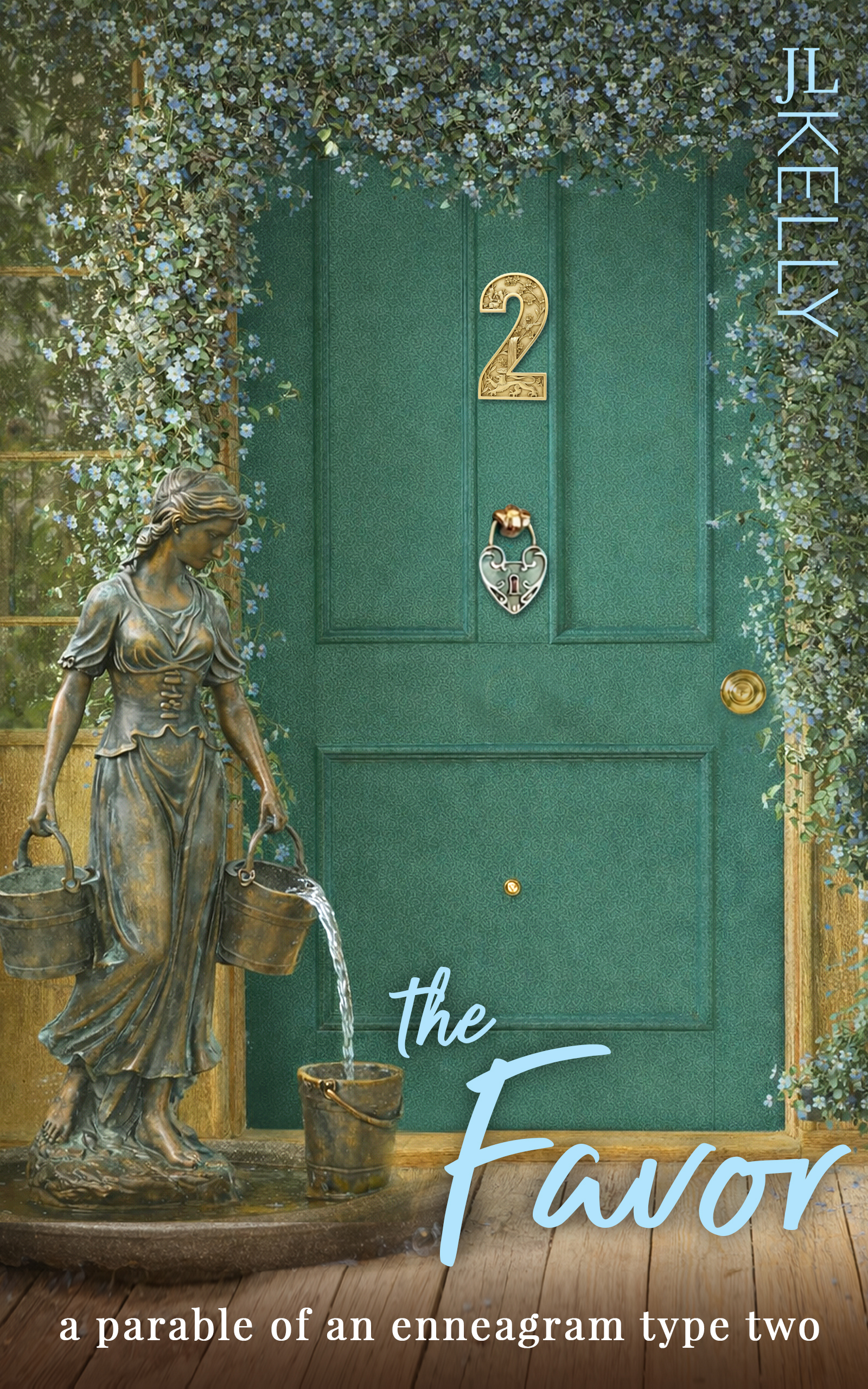
The first book in the series, The Favor: A Parable of an Enneagram Two, will be released in February 2026. Tender, romantic, and quietly transformative, The Favor is a contemporary Christian literary romance and modern parable about the Helper’s journey from earning love to receiving it, and discovering that true belonging begins not in sacrifice, but in grace.
This work is given in trust, bound to the mast, and sailing past the Sirens toward home.
“For any creative, offering their work is an act of courage. It is the choosing to place heart and soul, imagination and truth, into another’s care. I honor the intimacy between writer and reader as a sacred exchange. With each word, I offer my trust and receives yours, believing that when two imaginations meet with openness, something holy is born.” JL Kelly
 4jlkelly