Hope. Day 39 of Lent. Hope springs eternal.
They call it March Madness. To determine the national champion of men’s NCAA Division I college basketball, 68 teams play in a single-elimination tournament. They use Bracketology to predict the field of participants and as each college is announced there is unrivaled joy and excitement to be issued an invitation.
People everywhere jump on the band wagon for the Big Dance, you don’t have to be a fan or even have your team make the cut. March Madness calls out to any one of every age to join in the Bracketology and make your best picks. It’s kind of like horse-racing to me. Everyone has their philosophy. Some spend hours analyzing; others go by the head coach, the schools record, some pick the underdog, you root for the home team, curse your rival to go out in round one and who doesn’t like a Cinderella team the first two rounds.
But if your team is in the tournament… it’s a nail-biting 67 games.
It all starts with such great hope.
But quickly, March Madness turns to March Sadness.
There’s only one winner in the end and 67 teams have met the devastation of loss.
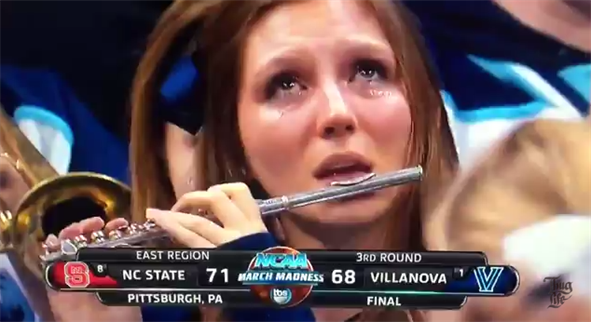
Villanova became the face of the disappointment.
It wasn’t a basketball player but a girl who played the piccolo with tears of devastation running down her face as the game came to an end. Like 67 other teams, Villanova lost.
There is something about Hope.
An expectation we feel that so quickly can be devastated by disappointment.
Holy week starts out that way.
The Hope of Hosanna!
Blessed is he who comes in the name of the Lord.
And yet by Friday Jesus Christ is cursed.
The fickle crowd crying out, “Crucify him!”
The disciples scattered.
The Lord dead and buried; sealed in a tomb.
God silent on Saturday.
All hope defeated.
Despair-the complete loss or absence of hope.
Webster’s defines Hope as a feeling of expectation and desire for a certain thing to happen. It reminds me of how the world defines love as a feeling instead of a commitment. To most hope is a feeling that what is wanted will happen and can denote either a baseless optimism or a vague yearning after an unattainable good.
Holman Bible Dictionary defines Biblical hope as the anticipation of a favorable outcome under God’s guidance.
More specifically, hope is the confidence that what God has done for us in the past guarantees our participation in what God will do in the future. If hope is to be genuine hope, however, it must be founded on something (or someone) which affords reasonable grounds for confidence in its fulfillment.
“We who have taken refuge (in God’s promises) would have strong encouragement to take hold of the hope set before us. This hope we have as an anchor of the soul, a hope both sure and steadfast” Hebrews 6:18-19
The Bible bases its hope in God and His saving acts and uses the vocabulary of hope; that those who hope hold to the truth, endure, and wait expectantly.
During the Passion week Sunday booms with hope. The disciples could see it coming, Jesus would be king and they would be elevated as rulers in His kingdom. “Expectation is the root of all heartache” William Shakespeare said and it is true. What heartache on Good Friday- how excruciating the disappointment. And Saturday, how numb the grief. We’re frightened to even feel a thing, much less hope. We all have our ‘Spiritual Saturdays’ when all seems lost and life seems empty. Its like when the seconds tick down to the buzzer and your team misses that last shot. You lost. You’re out. The TV goes black. You’re a part of March Sadness.
Sunday is coming. The resurrection is the ultimate victory.
Christ overcame. He is alive. And hope is alive. And in it, we live.
Along with faith and love, hope is eternal.
Hope springs eternal in the human breast;
Man never is, but always to be blessed:
The soul, uneasy and confined from home,
Rests and expatiates in a life to come.
– Alexander Pope, An Essay on Man
 4jlkelly